Being a child in an asylum center
Improve opportunities for accompanied children in care
Families with children form a unique group within asylum reception. How can we strengthen the opportunities for children and families in reception centres? That was the central question explored by the Knowledge Centre for Family Studies at Odisee, at the request of Fedasil, in close cooperation with the Children's Rights Commissariat, and with the support from the European Fund for Asylum, Migration and Integration (AMIF)..
Over the course of two years, researchers interviewed nearly 150 children, young people, families, care providers, and policymakers in reception centres.
Results
- A bilingual book (NL/FR) giving voice to children, parents, and reception staff, based on our research;
- A trilingual vision statement (NL/FR/ENG) on appropriate support for children and families in reception centres, co-created with Fedasil, Red Cross, Caritas, Croix Rouge, and the Children’s Rights Commissioner;
- A training package to help implement this vision in daily reception practices;
- An analysis tool in two languages (NL/FR) enabling reception centres to assess and improve their child- and family-friendly approach;
- An experience-based tool in two languages (NL/FR) that invites users to view life in a reception centre through the eyes of the children living there.
On 17 June 2022, during a bilingual study day at Campus Schaarbeek, we presented the research findings and handed over the book and vision statement to reception partners and policymakers; 70 people attended.
The French version of the book was published in June 2023.
On 13 June 2024, we introduced the analysis tool during a bilingual training session for asylum centre staff.
On 25 March 2025, we presented the experience-based tool during a bilingual study morning for asylum centre staff.
Other outputs
- The researchers reported on the research in three chapters in the book ‘Gezinnen na migratie. Hulpverlening en gezinsbeleid in een superdiverse samenleving’, published in May 2022.
- On Feb. 3, 2022, the researchers published the opinion piece 'Hoe maak je van asielcentra kindvriendelijke plekken?' on Social.Net.
- The researchers gave presentations at the IMISCOE (International Migration Research Network) conference in March 2022 (Duisburg, online) and in June-July 2022 in Oslo.
- On Nov. 20, 2023, Katja Fournier was a guest at the Acco webinar on the occasion of Children's Rights Day. There she gave the presentation 'Kind zijn in een asielcentrum: Hoe beleven zij (on)veiligheid en wat betekent dit voor hulpverleners?'. You can watch the recordings of the webinar here.
- In the Working Paper 'Wat asielzoekers en opvangmedewerkers delen' for the Association Working Group 'Social Work Research' KU Leuven (2024) Katja Fournier, Kaat Van Acker & Dirk Geldof analyze how social workers in the often precarious residential settings have to relate to the injustice they face daily and of which they are part. They ask for more attention to this in intervision and supervision.
- On June 16, 2023, Dirk Geldof presented this project at the Internationale Migrationskonferenz "Jugend in Migrationsgesellschaften" in Cologne: Growing up in an asylum center. The lived experience of children & youngsters in Belgian asylum centers.
- Van Acker, K., Fournier, K., & Geldof, D. ( April 13 2023). Narratives of parenthood and childhood among refugee families residing in collective reception centers: On declining parental agency and institutionalized forms of parentification. Paper presented at ECSWR conference "Social work research through and towards human relationships".
- Fournier, K., Van Acker, K. & Geldof, D. (2023). How to work together on/for safer shelters for (asylum-seeking) children? Flemish-Dutch Conference Research Social Work and Pedagogy (14-15 September 2023).
- Van Daele, S., Piessens, A., The center through children's eyes: unexpected reactions as an eye-opener for reflection on daily interaction with children. Flemish-Dutch Conference Research Social Work and Pedagogy (14-15 September 2023)
- Guest lecture 'Growing up in an asylum center. The lived experience of children & youngsters in Belgian asylum centers.' at the University of Lille (France) by Dirk Geldof (October 3, 2023)
- Keynote- Introduction générale pour la conférence " Quel accueil ": Area 42 Bruxelles (23/01/2023)
- Siska van Daele - An Piessens : Exploring the world with children on the run: a plea for flexible participation practices in shelters and schools. Contribution for the Growing Up Congress (08/12/2023)
- The European Journal of Social Work published in May 2025 the article 'Isomorphism between refugee families and social workers: a socio-spatial and temporal perspective on social work in asylum centers in Belgium'
Next Steps
Between 2023 and 2025, we continue working with AMIF funding to promote more child- and family-friendly asylum reception within the Fedasil, Red Cross, Caritas, and Croix Rouge networks. This includes:
- Research;
- Training;
- Development of analysis tools;
- On-site support for reception centres.
From the Knowledge Centre, Katja Fournier, Dirk Geldof, Anke Heyerick (until Jan 2024), Margot Lavent (from Nov 2023), Kaat Van Acker, and Claire Wiewauters are involved in the follow-up research.
Our partners are the Onderzoekscentrum Pedagogie in de Praktijk of the Karel de Grotehogeschool and the French-speaking colleagues of Défense des Enfants Belgique (DEI)..
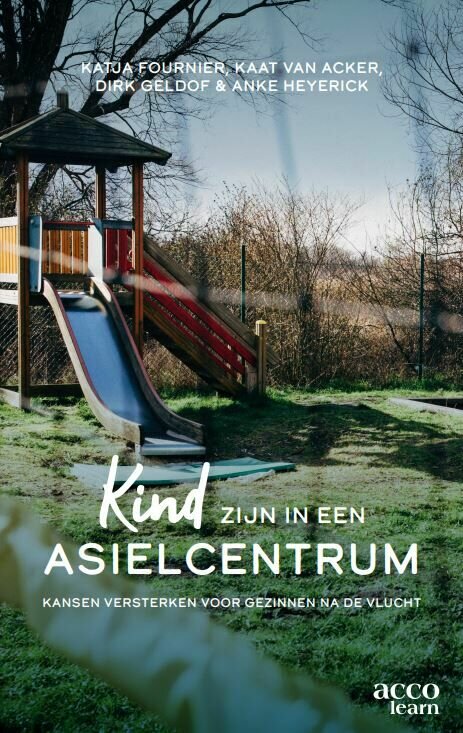
Being a child in an asylum center
How do children and families experience current reception centres? How do parents fulfil their role within existing limitations? What challenges do staff face? And most importantly: how can we create child- and family-friendly reception centres?
This book amplifies the voices of children, parents, and reception staff, based on research conducted in asylum centres. It offers practical tips to improve daily operations and makes policy recommendations for a more child- and family-oriented reception system — so that children on the move can first and foremost be children, with the best possible chances for their future.
Contents:
- Better support for children and families in reception
- Towards a child-centred vision in co-creation: methodology and approach
- Childhood and parenthood in reception centres
- Supporting positive family dynamics
- The (un)safety of reception centres for children and families
- Working together towards safe reception centres
- Promoting the psychosocial wellbeing of families
- Connecting to education and leisure
- Working in a child- and family-friendly way as a reception staff member
- The ways forward… Policy recommendations
You can preview the book or order it from the publisher.
Eight guiding principles for child- and family-friendly care
In the first phase of the research, we mapped out international perspectives and good practices in reception centres, as well as the support needs of children, parents, and care providers. This was done through a literature review and an exploration of good practices in Belgium, the Netherlands, Germany, France, and Finland — covering both network-wide policies and operational practices — based on interviews and site visits. Additionally, nine case studies of reception centres in Flanders and Wallonia were conducted, including interviews with children, parents of (young) children, and care providers. The children were interviewed using a methodology developed by our Knowledge Centre: Rooting in New Soil.
Based on the findings from this preliminary research, we developed a vision statement in co-creation with reception partners from Fedasil, Red Cross, Caritas, Croix Rouge, and the Children’s Rights Commissioner.
The vision statement outlines the basic conditions and key considerations for child- and family-friendly reception, based on eight guiding principles aimed at strengthening the opportunities for children in reception.
This vision statement is available in Dutch, French, and English.
How child-friendly is your shelter?
Based on the vision statement, we developed an analysis tool to assess the child-friendliness of asylum reception.
Using this tool, reception centres can evaluate their own practices and identify opportunities for improvement.
It marks a new step toward further operationalising this shared vision.
The shelter through children's eyes
The experience-based tool focuses on the perspective of children. It can be used alongside the analysis tool. Where possible, links are made between themes in the analysis tool and this experience-based tool.
However, it is not a child-friendly version of the analysis tool. Instead, it immerses users in the lived reality of children. After all, child-friendliness in a reception centre means not only providing care for children, but also ensuring that care reflects their ideas, perceptions, and experiences.
The shelter through children's eyes
The experience-based tool focuses on the perspective of children. It can be used alongside the analysis tool. Where possible, links are made between themes in the analysis tool and this experience-based tool.
However, it is not a child-friendly version of the analysis tool. Instead, it immerses users in the lived reality of children. After all, child-friendliness in a reception centre means not only providing care for children, but also ensuring that care reflects their ideas, perceptions, and experiences.
Press articles following the book launch
- Onderzoekers brengen leefwereld van kinderen in asielcentra in kaart: “Velen krijgen direct of indirect te maken met vormen van geweld”, Gazet van Antwerpen, 17/06/22
- Belgische asielcentra geen veilige plek voor kinderen: ze zien er geweld en seksueel overschrijdend gedrag, Het Laatste Nieuws, 17/06/22
- Belgische asielcentra “niet veilig”: “Kinderen zien geweld en seksueel overschrijdend gedrag”, in Het Nieuwsblad and in Het Belang van Limburg, 17/06/22
- Asielcentra moeten gezins- en kindvriendelijker. Onderzoeker Dirk Geldof legt uit hoe dat kan, in een interview met De Standaard, 21/06/22.
Training, formation and intervision sessions
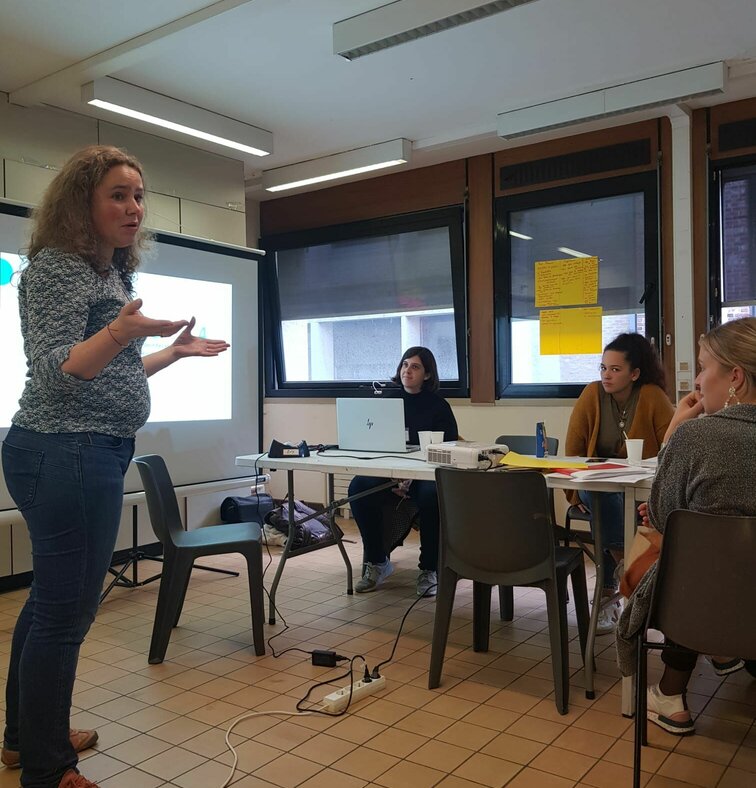
In addition to our vision statement, we offer training, educational sessions, and intervision workshops to reception partners, in both Dutch and French. These sessions are grounded in practice, featuring a variety of hands-on and reflective exercises. We also provide theoretical frameworks with direct links to practical application.
What does the training look like in practice?
The goal is to motivate, inform, and support staff, while offering concrete tools on:
- the needs of children and families (Module 1),
- supporting positive family dynamics (Module 2),
- and increasing safety for children and families in the centre (Module 3).
We learn to address parents more in their parental role, give parents more participation, inform them better so we can work together, look together for solutions that work better for the children.